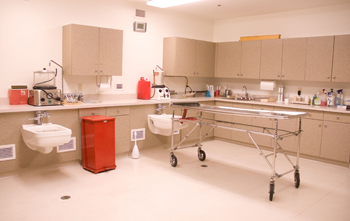

Embalming, in most modern cultures, is the art and science of temporarily preserving human remains to forestall decomposition and to make them suitable for display at a funeral. The three goals of embalming are thus sanitization, presentation and preservation (or restoration) of a dead body to achieve this effect. Embalming has a very long and cross-cultural history, with many cultures giving the embalming processes a greater religious meaning.
History
Embalming has been practiced in many cultures and is one of the earliest surgical procedures humanity undertook. In classical antiquity, perhaps the Old World culture that had developed embalming to the greatest extent was that of ancient Egypt, which developed the process of mummification. They believed that preservation of the mummy empowered the soul after death, which would return to the preserved corpse.
Other cultures that had developed embalming processes include the Incas and other cultures of Peru, whose climate also favored a form of mummification. The sankar empire also had a form of mummification.
However some of the best preserved bodies in the world are from Han dynasty China, although the preservation process is still incompletely understood. It seems a special liquid, in which the bodies were embedded, was of major influence.
Embalming in Europe had a much more sporadic existence. It was attempted from time to time, especially during the Crusades, when crusading noblemen wished to have their bodies preserved for burial closer to home. Embalming began to come back into practice in parallel with the anatomists of the Renaissance who needed to be able to preserve their specimens. Arterial embalming is believed to have been first practiced in the Netherlands in the 17th century by Frederik Ruysch but his liquor balsamicum preservative was kept a secret to the grave and his methods were not widely copied.
Contemporary embalming methods advanced markedly during the American Civil War, which once again involved many servicemen dying far from home, and their family wishing them returned for local burial. Dr. Thomas Holmes received a commission from the Army Medical Corps to embalm the corpses of dead Union officers to return to their families. Military authorities also permitted private embalmers to work in military-controlled areas. The passage of Abraham Lincoln’s body home for burial was made possible by embalming and it brought the possibilities and potential of embalming to a wider public notice.
In 1867, the German chemist August Wilhelm von Hofmann discovered formaldehyde, whose preservative properties were soon discovered and which became the foundation for modern methods of embalming.
In the 19th and early 20th centuries arsenic was frequently used as an embalming fluid but has since been supplanted by other more effective and less toxic chemicals. There were questions about the possibility of arsenic from embalmed bodies later contaminating ground water supplies. There were also legal concerns as people suspected of murder by arsenic poisoning could claim that the levels of poison in the deceased’s body were a result of embalming post mortem rather than evidence of homicide.
Modern embalming is most often performed to ensure a better presentation of the deceased for viewing by relatives and friends. A viewing is considered by many authorities to be helpful in the grieving process. Embalming is also a general legal requirement for international repatriation of human remains (although exceptions do occur) and by a variety of laws depending on locality, such as for extended time between death and final disposition or above ground entombment.